
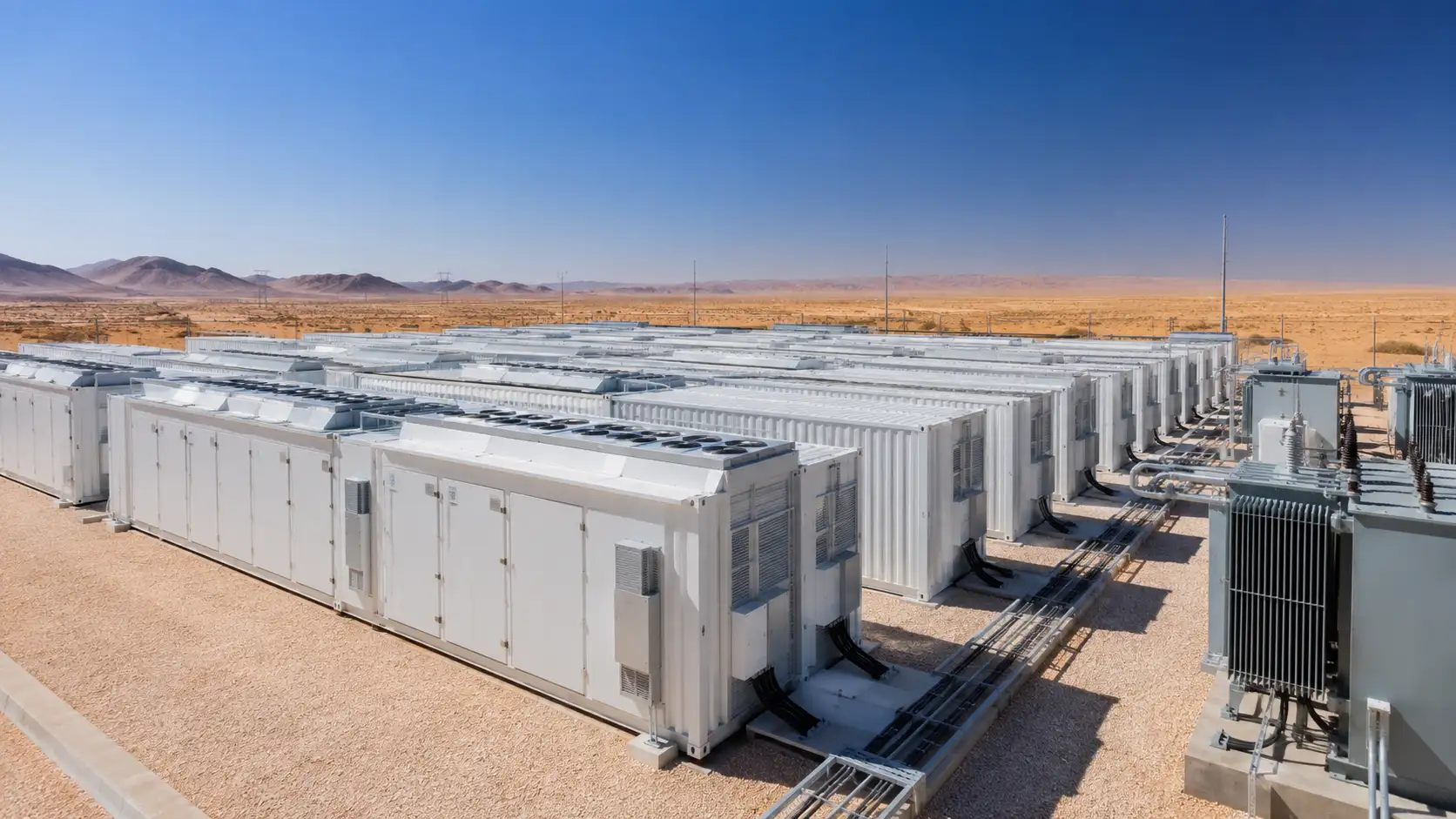
What Is a Battery Energy Storage System (BESS)? A Technical and Commercial Guide for the Middle East
By Dr. Hossein Golestani, PhD (Electrical Engineering) — VOLTFORD FZCO, Dubai
The Gulf has spent a decade proving it can generate the cheapest solar power on earth. The next decade is about controlling when that power reaches the grid.
That shift is already visible in procurement. Saudi Arabia is targeting 48 GWh of battery energy storage by 2030, with roughly 50 GWh of large-scale capacity now being procured, built or tendered in the Kingdom. In the UAE, Masdar and EWEC are pairing 5.2 GW of solar with 19 GWh of storage in a project designed to deliver round-the-clock renewable capacity. Regionally, industry analysts describe this as a decisive shift: solar has moved from being seen as a cheap but intermittent supplement to the fossil-fuelled grid, to forming the backbone of a renewable-powered grid that supplies capacity around the clock.
Storage is what makes that possible. This guide explains what a battery energy storage system actually is, how each component shapes the commercial outcome, and which design decisions matter most in a region where ambient temperatures, dust and 4-hour discharge requirements set the engineering agenda.
What is a BESS?
A battery energy storage system (BESS) is an engineered installation that draws electrical energy from a source, stores it electrochemically, and releases it on command with millisecond-level responsiveness.
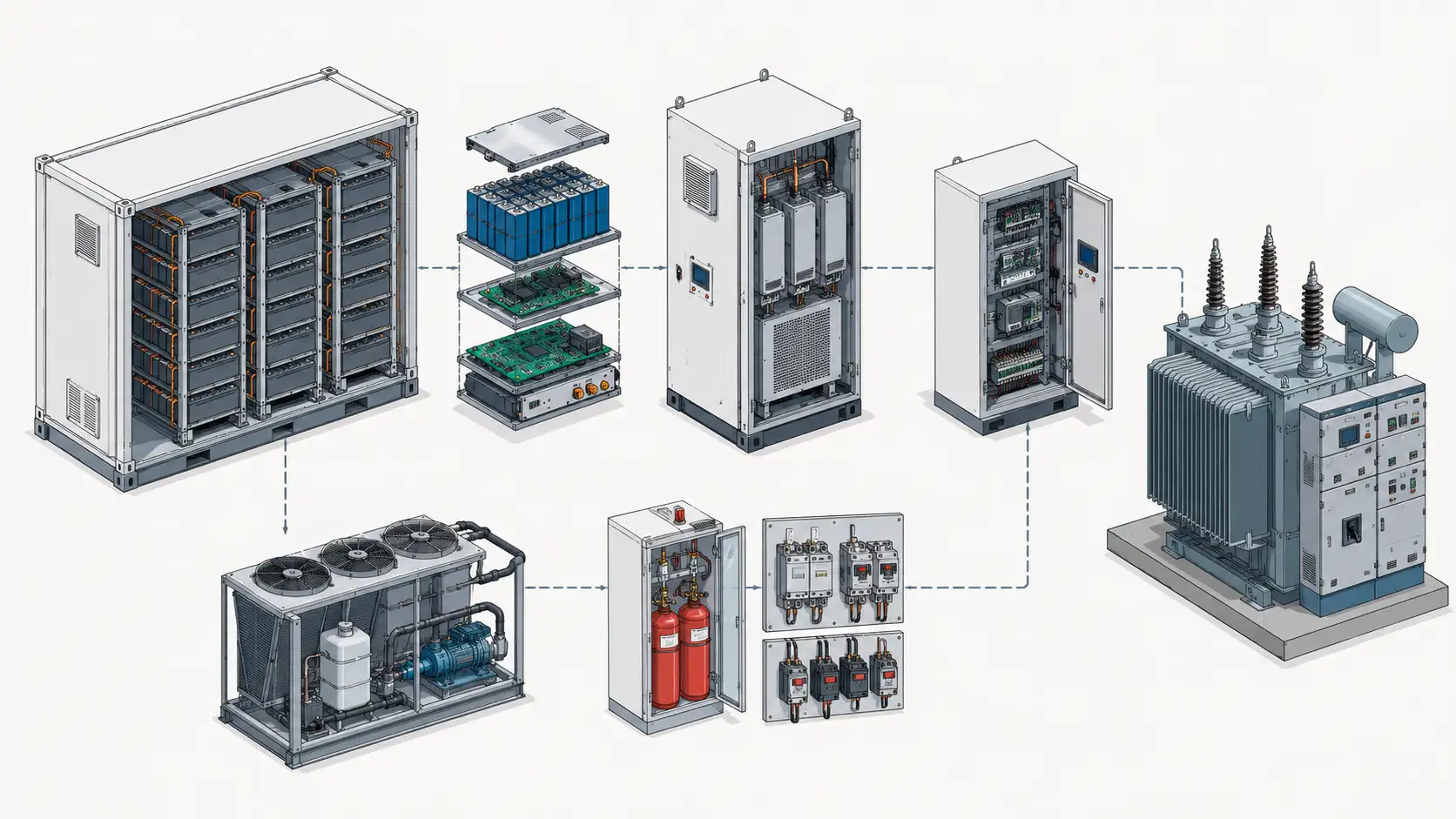
The point that separates professional practice from casual understanding: a BESS is not simply a large battery. It functions as a complete power plant. The battery cells are only one of seven subsystems, and the balance of the installation — power conversion, controls, thermal management, protection and grid interface — determines performance, safety, bankability and lifetime revenue.
Every BESS carries two independent ratings:
- Power (MW) — how fast it can charge or discharge
- Energy (MWh) — how much it can store
The relationship between them is duration. This is not an abstract parameter in the Gulf: Saudi Arabia’s Independent Storage Provider tenders are structured around 500 MW / 2,000 MWh units — precisely four hours of discharge — because four hours is what it takes to carry the grid from the solar afternoon through the evening demand peak.
The seven building blocks of a BESS
1. Cells, modules and racks
Cells are grouped into modules, modules into racks, racks into containers. Lithium iron phosphate (LFP) has become the dominant chemistry in stationary storage, combining long cycle life, high thermal stability and competitive cost — and LFP cell prices have moved below USD 100/kWh, which is a substantial part of why GWh-scale projects now clear economically.
2. Battery management system (BMS)
The BMS monitors voltage, current and temperature at cell level, balances the pack and enforces safe operating limits. It protects the warranty and the asset, and performance guarantees in this industry typically rely on BMS data.
3. Power conversion system (PCS)
The bidirectional inverter that converts DC storage to AC grid power and back. In high-renewable Gulf grids its capability set is under real scrutiny: market analysts note that four-hour lithium-ion systems have in some cases struggled to meet grid code requirements for frequency response in high-renewable scenarios, extending procurement timelines and technical qualification. Specifying the right power electronics at design stage is not a detail — it is the difference between a system that qualifies and one that waits.
4. Energy management system (EMS)
The EMS decides what the battery does each moment: when to charge, when to discharge, when to hold reserve, which contract obligation to serve. Two identical batteries under different control strategies produce materially different annual revenue.
5. Thermal management
In this region, thermal design is the single most consequential engineering choice after duration. Cell life and usable capacity depend on keeping cells within a narrow temperature band while ambient conditions push hard in the opposite direction. Liquid cooling is widely used in modern utility-scale systems for exactly this reason, and correctly sized thermal capacity is what preserves cycle-life guarantees across a 15-to-20-year asset life in Gulf conditions.
6. Protection and fire safety
DC and AC protection devices, fuses, surge protection, isolation, gas detection and suppression. This layer rarely features in marketing material, yet it is what insurers, civil defence authorities and lenders examine most closely. Correct component selection here is a bankability issue.
7. Grid interface
Medium-voltage transformer, switchgear, metering and grid protection — the equipment that makes the installation a compliant market participant. Saudi Arabia’s recently connected 7.8 GWh of storage across three southern sites, for instance, interfaces with the transmission network at 380 kV.
The five numbers that decide the business case
- Duration. How many hours the system can discharge at rated power. Four hours has become the regional standard for utility-scale procurement because it matches the gap between solar generation and evening peak demand.
- Round-trip efficiency. Modern LFP systems achieve charge and discharge efficiencies around 95% in each direction, giving system-level round-trip efficiency in the high-80s to low-90s percent range. Every efficiency point flows directly into arbitrage or contracted margin.
- Cycle life and degradation. Capacity fades with use, and heat accelerates it. Professional projects plan augmentation — adding capacity mid-life to maintain contracted output — and model replacement costs into the financial case from day one.
- Availability. Contracted revenue depends on the asset being available when called. Under capacity-payment and tolling structures, availability guarantees are a core commercial term, not a technical footnote.
- C-rate. How aggressively the system can cycle relative to its energy capacity, which determines which fast-response services it can provide.
Architecture choices that shape returns
Front-of-meter vs behind-the-meter
Front-of-meter systems sell capacity and services to utilities and offtakers — the model behind Saudi Arabia’s Independent Storage Provider tenders. Behind-the-meter systems reduce a commercial or industrial consumer’s own costs, which in the UAE means reducing exposure to demand-based tariff structures and, in Abu Dhabi, to summer peak pricing.
Standalone vs co-located
A battery installed alongside an existing solar plant can share the site, the grid connection, the medium-voltage infrastructure and the operating team. Where connection capacity and land are the constraint, co-location is usually the most capital-efficient path.
AC-coupled vs DC-coupled
DC coupling shares an inverter with the PV plant and captures energy that would otherwise be clipped; AC coupling gives the battery independent dispatch and is generally simpler to retrofit into an operating plant.
How a BESS earns money in this region
The revenue logic in MENA differs from Europe’s merchant-trading model, and it is arguably more attractive:
- Capacity payments and contracted availability. The UAE’s 19 GWh framework is structured so that storage earns capacity payments independent of energy throughput. Saudi Arabia’s ISP projects are procured on a build-own-operate model, with the winning consortium holding 100% equity in the project company.
- Solar shifting. Moving generation from the solar afternoon into the evening peak, which is what turns intermittent PV into firm capacity.
- C&I tariff management. Reducing demand exposure and shifting consumption. In Abu Dhabi, large industrial customers above 1 MW pay roughly 36.6 fils/kWh during summer peak hours (10:00–22:00, June to September) against 27.0 fils/kWh off-peak — a spread of about 35.6% that a battery can arbitrage directly.
- Diesel displacement. In off-grid and weak-grid applications across the region, storage paired with solar displaces diesel generation, with off-grid systems delivering electricity at costs below USD 0.10/kWh.
Cost trajectories reinforce all of this: analysts project that by 2027, solar plus four-hour storage could clear below 3 US cents per kWh, undercutting the short-run marginal cost of gas peakers and reshaping how these grids dispatch.
The regional picture
Saudi Arabia is the largest BESS market in MENA, driven by multi-year public procurement and consistent annual tenders. The Kingdom connected 7.8 GWh across three sites in December 2025, and the Saudi Power Procurement Company opened qualification in April 2026 for a second group of six projects totalling 3 GW / 12 GWh, each 500 MW / 2,000 MWh on a build-own-operate basis, with 27 companies prequalified by July 2026.
The UAE is pairing utility-scale solar with storage at unprecedented scale, including the Masdar/EWEC round-the-clock project supported by a 7.5 GWh supply agreement with Sungrow, while DEWA has commissioned the region’s first pumped-hydro storage at Hatta (250 MW / 1,500 MWh). Behind the meter, Dubai free zone tenants are deploying rooftop PV specifically to reduce exposure to demand-based tariffs.
Across MEA, the battery energy storage market is projected to grow at roughly 19.2% CAGR between 2026 and 2031, reaching about USD 6.86 billion, with Saudi Arabia expanding faster still at close to 23%. Globally, storage passed 250 GW in 2025 and overtook pumped hydro, with additions in 2026 projected to exceed 130 GW / 350 GWh — and the Middle East is named among the regions gaining importance.
North Africa is following the same path, with the first utility-scale BESS projects reaching financial structure — including a 220 MW hybrid renewable project coupled with 370 MWh of storage in Mauritania — and battery manufacturing localising, notably a 20 GWh-per-year gigafactory in Morocco scaling from 2026.
Why engineering choices are commercial choices
Duration, inverter capability, thermal design, protection selection and grid interface are not technical footnotes. Each determines which revenue streams a project can access, what an offtaker will contract, what a lender will underwrite and what an insurer will cover. In a climate that punishes under-specified thermal systems and a grid environment where frequency-response qualification is a live constraint, a battery specified without that commercial lens leaves value on the table for two decades.
Figures cited are indicative market data from the sources listed below; actual project results are site- and structure-specific.
How VOLTFORD supports BESS projects
VOLTFORD FZCO is an engineering-led supplier and technical partner in the solar and storage sector, based in Dubai, UAE, and working alongside our engineering affiliate Intelluma GmbH in Munich, Germany — European engineering practice with a Gulf presence and Gulf logistics.
Our foundation is technical. The company is led by a PhD electrical engineer, and our track record includes multi-megawatt module procurement with independent factory and pre-shipment inspection, supply of protection and balance-of-system components, and battery deliveries to clients in the Middle East. We are extending that capability into BESS supply and associated engineering services for power plants across the Middle East and North Africa — from component specification and supplier qualification to system sizing, harsh-climate design review and business-case modelling.
Two ways to start:
- Request a site-specific business-case assessment — we model your site, duration options and revenue structure, and show you the numbers before you commit.
- Talk to us about component supply — batteries, protection devices, cables and balance-of-system equipment with documented conformity for GCC markets.
Frequently asked questions
What does BESS stand for?
BESS stands for Battery Energy Storage System: a complete installation of battery cells, power conversion, control, thermal management, protection and grid-interface equipment that stores electrical energy and delivers it on demand.
What is the difference between MW and MWh in battery storage?
MW measures power — how quickly the system can charge or discharge. MWh measures energy — how much it can store. Dividing energy by power gives duration; a 500 MW / 2,000 MWh system, the standard unit in Saudi Arabia’s storage tenders, is a four-hour battery.
Why are Gulf storage projects usually four hours?
Because four hours covers the gap between peak solar generation in the afternoon and peak electricity demand in the evening. Saudi Arabia’s Independent Storage Provider projects are each structured as 500 MW / 2,000 MWh precisely for this reason.
Which battery chemistry is used for grid storage in the Middle East?
Lithium iron phosphate (LFP) dominates, because it combines long cycle life, strong thermal stability and competitive cost, with cell prices now below USD 100/kWh.
How does extreme heat affect a battery storage system?
Temperature drives both capacity availability and degradation rate. This is why thermal management, and liquid cooling in particular, is central to utility-scale design in this region, and why thermal capacity must be sized for actual site conditions rather than nominal ratings.
How long does a BESS last?
Utility-scale systems are typically designed for 15 to 20 years of service. Capacity declines gradually with cycling, and professional projects plan capacity augmentation during the asset’s life to maintain contracted output.
Sources
- Energy-Storage.News — Saudi Arabia begins qualifying bidders for 3GW/12GWh battery storage RFP (April 2026)
- ESS News — Saudi Arabia launches qualification process for 12 GWh of battery storage projects (April 2026)
- Enerdata — Saudi Arabia’s SPPC opens tender for six BESS projects totalling 3 GW/12 GWh (May 2026)
- Chambers and Partners — Power Generation, Transmission & Distribution 2026: Middle East
- Middle East and Africa Battery Energy Storage System Market
- UAE Solar Energy Market
- United Arab Emirates Power Market 2026–2036
- Energy Storage Outlook (May 2026)
- MENA Energy Outlook 2026
- UAE Utility Bill / Abu Dhabi tariff guides 2026