Adding Battery Storage to an Existing Solar Plant: The Co-Location Opportunity in MENA
By Dr. Hossein Golestani, PhD (Electrical Engineering) — VOLTFORD FZCO, Dubai
If you own an operating solar plant anywhere in the Gulf or North Africa, you already hold the two assets that new storage developers spend years assembling: a grid connection and a permitted, built site.
That position is becoming more valuable every quarter. Across the region, procurement has shifted decisively — industry analysis of the MENA power market describes solar moving from a cheap but intermittent supplement to the fossil-fuelled grid, to forming the backbone of a renewable-powered grid that provides around-the-clock capacity. The flagship example is Masdar and EWEC’s Abu Dhabi project, which pairs 5.2 GW of solar with 19 GWh of storage explicitly to deliver renewable power continuously rather than intermittently.
Every solar plant already in the ground is a candidate to make the same transition. This article explains why, what the co-location advantage consists of, and how the economics work.
The problem worth solving: your best generation hours are not the grid’s peak hours
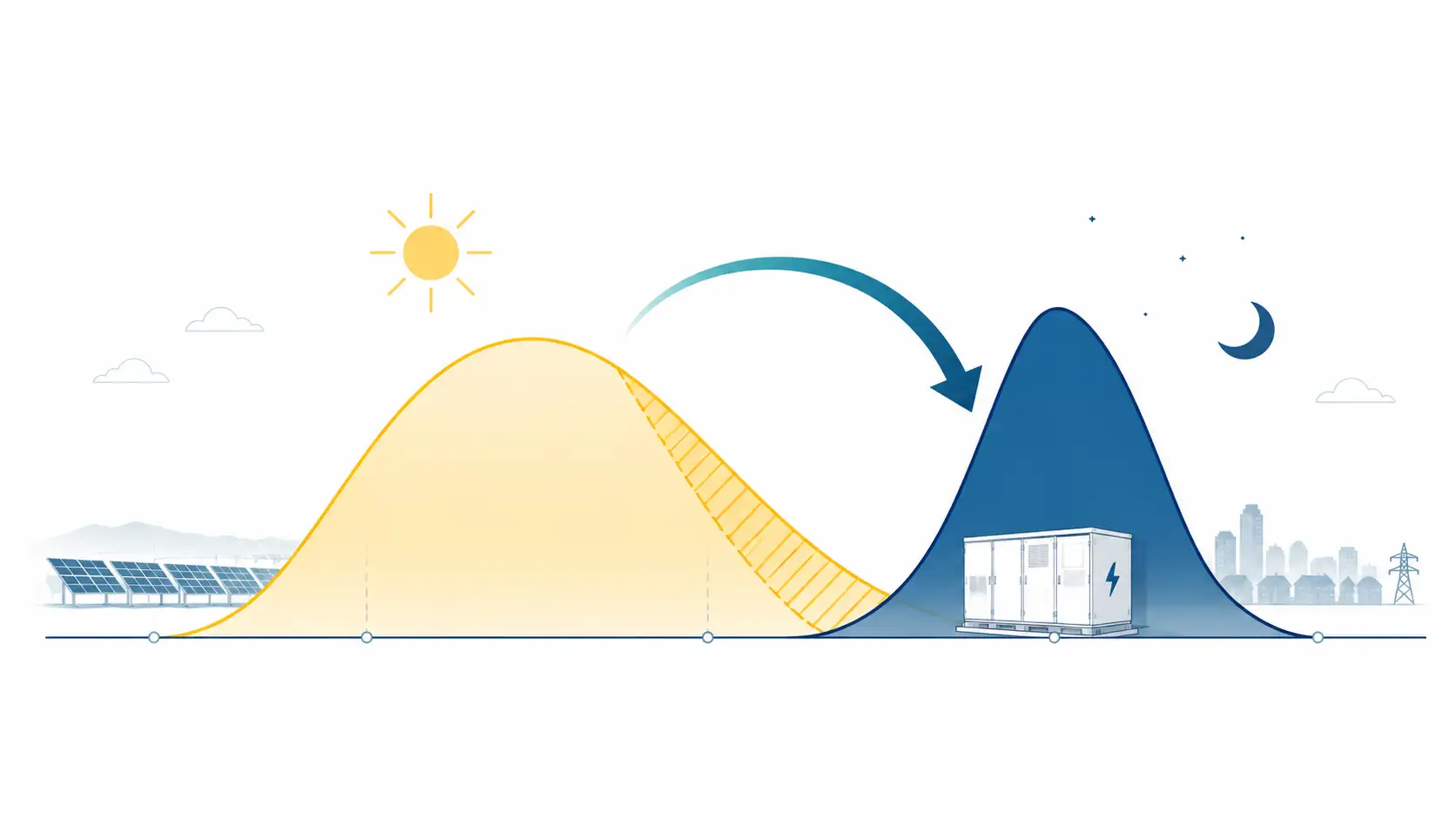
Gulf solar plants produce their maximum output in the early afternoon. Regional electricity demand peaks later, driven by cooling load that runs into the evening and holds long after solar output has fallen away. The mismatch is structural, and it has two consequences for a plant owner.
The first is curtailment. As solar penetration rises, system operators increasingly have more midday generation than the grid can absorb. Saudi Arabia alone saw solar curtailment of roughly 1.2 TWh in 2025 — energy that was produced and then not used, which is one of the drivers behind the Kingdom’s move to procure storage at multi-GWh scale.
The second is value. Firm, dispatchable capacity in the evening peak is worth considerably more to an offtaker than uncontrolled afternoon generation. The entire regional procurement model is moving toward contracting capacity that is available when the system needs it, which is why the UAE’s 19 GWh framework is structured so that storage earns capacity payments independent of energy throughput.
A co-located battery addresses both at once. It absorbs generation that would otherwise be curtailed, and converts it into the product the grid is now paying for.
The co-location advantage
1. You use the grid connection you already have
A battery installed to serve an existing plant can generally share that plant’s connection point and export capacity, subject to the network operator’s assessment and the technical configuration of the site. In a region where transmission connection is often the long pole in the schedule, this is the single largest time advantage available to an existing asset owner.
2. Shared site, shared infrastructure, shared cost
Land, access roads, security, medium-voltage infrastructure, SCADA, grid protection and an operating team already exist. A retrofit reuses all of it. That is why co-located storage frequently reaches attractive returns with less capital per megawatt of delivered value than an equivalent greenfield project.
3. You convert an intermittent asset into a firm one
This is the commercial heart of it. A standalone solar plant sells energy when the sun decides. A solar-plus-storage plant sells capacity when the buyer decides. That distinction changes which contracts you can compete for, because the region’s flagship procurements are now written around round-the-clock delivery.
4. Falling storage costs are doing the work for you
LFP cell prices have moved below USD 100/kWh, and analysts project that by 2027 solar plus four-hour storage could clear below 3 US cents per kWh, undercutting the short-run marginal cost of gas peakers. Every quarter that passes improves the retrofit case for a plant that is already built and already connected.
What the market is contracting
The scale of regional procurement tells you how firmly this model is established:
| Market | Storage development |
|---|---|
| Saudi Arabia | Targeting 48 GWh by 2030; roughly 50 GWh being procured, built or tendered; 7.8 GWh connected across three southern sites in December 2025 at 380 kV |
| Saudi second ISP round | Six projects of 500 MW / 2,000 MWh each — 3 GW / 12 GWh total, build-own-operate, with 27 companies prequalified by July 2026 |
| UAE | 19 GWh framework with capacity payments independent of energy; Masdar/EWEC round-the-clock project supported by a 7.5 GWh Sungrow supply agreement |
| UAE (storage first) | DEWA’s Hatta pumped-hydro facility (250 MW / 1,500 MWh), the first operational pumped-hydro storage in the GCC |
| MEA market growth | Projected ~19.2% CAGR 2026–2031, reaching about USD 6.86 billion; Saudi Arabia growing at close to 23% |
| North Africa | First utility-scale BESS structures emerging, including 370 MWh paired with a 220 MW hybrid renewable project in Mauritania |
Four hours is the regional design point, because that is what carries a system from the solar afternoon into the evening peak. (For the underlying technical parameters — duration, round-trip efficiency, degradation and augmentation — see our BESS fundamentals guide.)
Behind the meter: the same logic for commercial and industrial plants
The retrofit case is not limited to utility-scale plants. Commercial and industrial sites with existing rooftop or ground-mount solar have an equally direct argument, and in some markets a sharper one:
- Abu Dhabi charges large industrial customers above 1 MW roughly 36.6 fils/kWh during summer peak hours (10:00–22:00, June to September) against 27.0 fils/kWh off-peak — a spread of about 35.6% that storage can arbitrage on the customer’s own meter.
- Dubai’s D33 Industry Friendly Power Policy allows factories to size rooftop systems up to full connected load, with compensation streamed at 10.5 fils/kWh and payback periods reported under four years. Adding storage extends the value of that same rooftop asset into the hours it cannot cover.
- Commercial tariffs across the UAE run roughly AED 0.20 to AED 0.38/kWh depending on emirate and customer class, and Dubai free zone tenants are already deploying behind-the-meter solar specifically to reduce exposure to demand-based tariff structures.
- Regulatory pull is strengthening. UAE Federal Decree-Law No. 11/2024, effective May 2025, converts voluntary climate commitments into binding obligations through a national carbon registry and verified reporting, obliging heavy industry to procure renewable electricity or purchase offsets.
- Egypt’s commercial and industrial solar segment is forecast to grow at roughly 23.8% CAGR through 2031, supported by a five-year electricity tariff freeze for high-voltage customers that lets factories lock in their cost base.
The engineering decisions that make a retrofit work
AC-coupled or DC-coupled. DC coupling shares the existing inverter infrastructure and captures energy that would otherwise be clipped at the inverter limit. AC coupling gives the battery independent dispatch and is generally simpler to add to an operating plant without disturbing existing performance guarantees. The right answer depends on your inverter loading ratio, remaining warranty terms and target revenue structure.
Sizing to the existing connection. Your export capacity is the frame. Correct sizing within it — rather than to a generic rule of thumb — is what determines whether the retrofit clears its hurdle rate.
Thermal design for actual site conditions. This is where Gulf projects succeed or disappoint. Ambient temperature drives both available capacity and degradation rate, and a thermal system sized for nominal conditions rather than real ones will not hold its contracted output through years eight to fifteen. Liquid cooling is widely used in utility-scale systems for precisely this reason.
Grid code qualification. Market analysis notes that four-hour lithium-ion systems have in some cases struggled to meet grid code requirements for frequency response in high-renewable scenarios, extending procurement timelines and technical qualification. Specifying compliant power electronics from the outset avoids that delay.
Protection, safety and insurability. DC protection, surge protection, isolation, gas detection and suppression are what civil defence authorities, insurers and lenders examine. Getting this layer right at design stage is what keeps a project financeable.
Figures cited are indicative market data from the sources listed below; actual project results are site- and structure-specific.
You do not need to fund it yourself
The most common assumption we encounter is that a retrofit requires the plant owner’s own capital. It does not. Build-own-operate structures, third-party ownership, storage-as-a-service and capacity-payment or tolling arrangements allow the battery to be financed and owned by a capital partner, while the site owner benefits through a lease, a revenue share or improved plant economics. Saudi Arabia’s Independent Storage Provider model is itself built on exactly this principle — the developer owns the asset and is paid for making capacity available.
What every one of these structures requires first is the same thing: a credible, site-specific technical and financial model. That is where a retrofit project actually starts.
How VOLTFORD supports solar-plus-storage retrofits
VOLTFORD FZCO is an engineering-led supplier and technical partner in the solar and storage sector, based in Dubai, UAE, working alongside our engineering affiliate Intelluma GmbH in Munich, Germany — European engineering practice with Gulf presence and Gulf logistics.
The company is led by a PhD electrical engineer. Our experience covers multi-megawatt module procurement with independent factory and pre-shipment inspection, supply of protection and balance-of-system components, and battery deliveries to clients in the Middle East. We are extending this into BESS supply and engineering services for power plants across MENA, including retrofit assessment for existing solar assets: duration and sizing analysis, AC/DC coupling comparison, harsh-climate thermal review, component specification, supplier qualification, and the business-case model a lender or storage investor expects to receive.
- Request a site-specific business-case assessment — send us your plant’s connection capacity, generation profile and location, and we will show you what a co-located battery could add.
- Talk to us about component supply — batteries, protection devices, cables and balance-of-system equipment with documented conformity for GCC markets.
Frequently asked questions
Can I add battery storage to a solar plant that is already operating? Yes. Retrofitting storage to an operating plant is one of the most capital-efficient options available, because the site, permits, grid connection and operating infrastructure already exist. The battery can generally share the plant’s connection point, subject to the network operator’s assessment.
What is co-located battery storage? Co-located storage is a battery installed at the same site as a generation plant, typically sharing its grid connection and infrastructure, as opposed to a standalone battery with its own connection point.
Why is storage being procured so heavily in Saudi Arabia and the UAE? Because solar generation peaks in the afternoon while demand peaks in the evening, and because curtailment rises as solar penetration grows — Saudi Arabia saw roughly 1.2 TWh of solar curtailment in 2025. Storage converts intermittent generation into firm capacity, which is what current procurement contracts for.
How many hours of storage should a retrofit have? Four hours has become the regional standard for utility-scale projects, matching the gap between peak solar output and peak demand. Saudi Arabia’s Independent Storage Provider projects are each 500 MW / 2,000 MWh. The optimal duration for a specific plant depends on its connection capacity, generation profile and offtake structure.
Does extreme heat make storage less viable in the Gulf? No, but it makes thermal engineering decisive. Temperature affects both available capacity and degradation rate, so systems must be specified for actual site conditions, which is why liquid cooling is standard in utility-scale installations in this region.
Who pays for the battery? It can be the plant owner, but it does not have to be. Build-own-operate, third-party ownership and storage-as-a-service structures let a capital partner finance and own the asset while the site owner benefits through a lease or revenue share.
Sources
- Chambers and Partners — Power Generation, Transmission & Distribution 2026: Middle East (round-the-clock capacity shift, Saudi tenders)
- Energy-Storage.News — Saudi Arabia begins qualifying bidders for 3GW/12GWh battery storage RFP (April 2026)
- Enerdata — Saudi Arabia’s SPPC opens tender for six BESS projects totalling 3 GW/12 GWh (May 2026)
- Energetica India — Saudi Arabia prequalifies firms for second round of 12 GWh battery storage projects (July 2026)
- Mordor Intelligence — Middle East and Africa Battery Energy Storage System Market (UAE 19 GWh framework, MEA CAGR)
- Mordor Intelligence — Middle East and Africa Battery Market (Sungrow 7.5 GWh, Mauritania, Morocco gigafactory)
- Mordor Intelligence — UAE Solar Energy Market (D33 policy, Federal Decree-Law 11/2024, solar-plus-storage cost trajectory)
- Mordor Intelligence — Egypt solar C&I outlook
- MarkWide Research — United Arab Emirates Power Market 2026–2036 (grid code qualification, free zone C&I)
- Dii Desert Energy — MENA Energy Outlook 2026 (Saudi BESS commissioning, DEWA Hatta)
- UAE Utility Bill — Business electricity tariffs UAE 2026 and Abu Dhabi tariffs 2026 (peak/off-peak spreads)